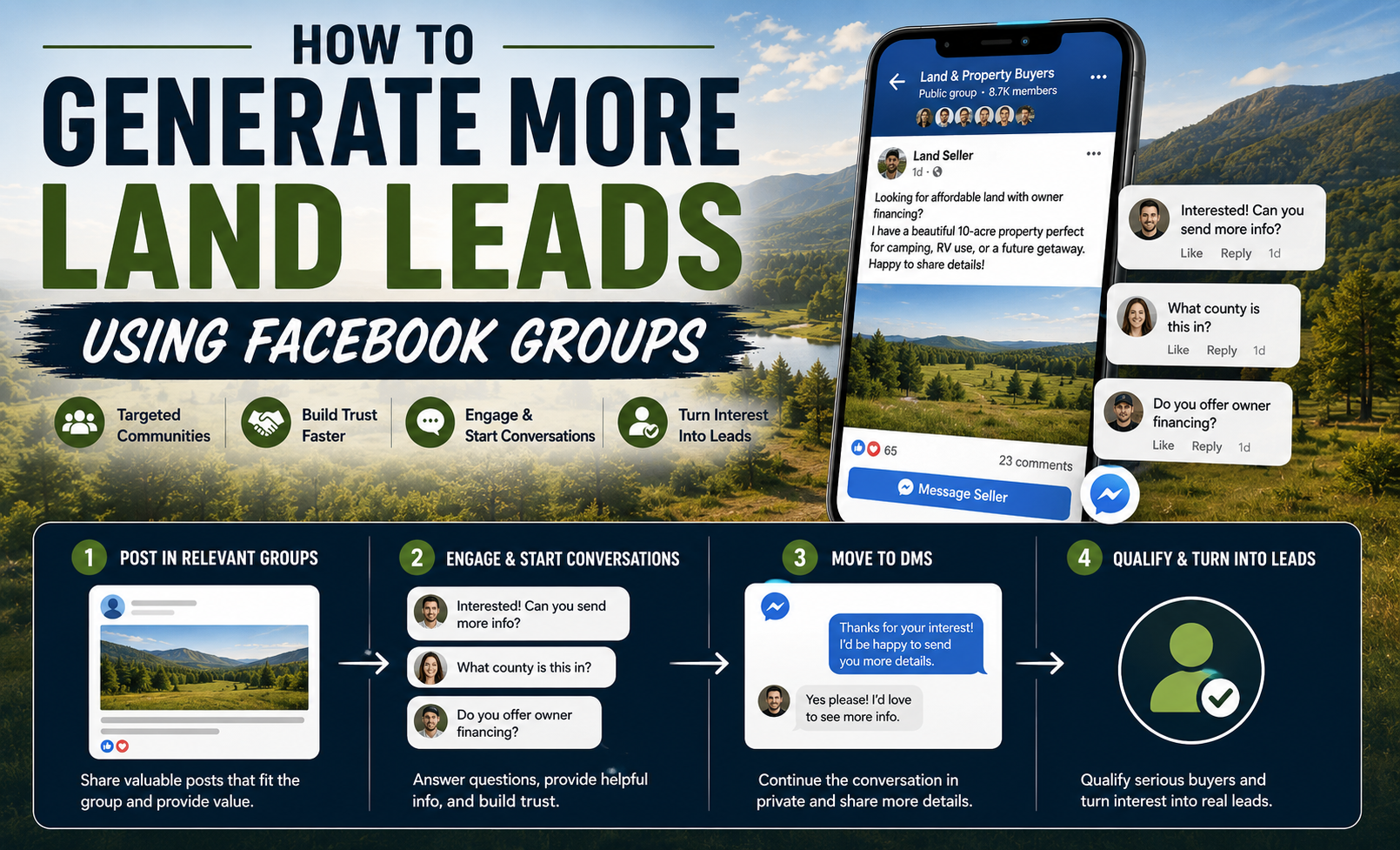
Most land sellers focus on paid ads first. But some of the most consistent land leads come from a channel that costs nothing — Facebook Groups.
The buyers are already there. The conversations are already happening. People are asking about affordable acreage, owner financing, off-grid land, and rural properties every single day in thousands of active groups. You do not need a large following, a big budget, or a polished brand to tap into that demand. You need the right groups, the right posts, and a consistent approach.
This guide walks you through a complete land marketing strategy for Facebook Groups — from finding the right communities to writing posts that generate conversations, following up fast, and avoiding the mistakes that get sellers removed or ignored.
Why Facebook Groups Work So Well for Land Sellers
Before you invest time into any channel, you need to know why it works. Here is what makes Facebook Groups one of the most effective tools for land lead generation.
Built-in targeted audiences. Groups are self-selected communities. Someone who joined a "Owner Financed Land" group is already interested in buying land on terms. Someone in a "Homesteading and Off-Grid Living" group is already thinking about rural property. You are not trying to create demand — you are entering conversations where demand already exists.
Lower cost than ads. Running a Facebook ad campaign requires budget, testing, and optimization. Posting in a group costs nothing except your time. For land sellers who are just starting out or who want to stretch their marketing further, groups offer real ROI without real spend.
Conversation-based selling. Groups are social spaces, not storefronts. When you post something helpful or interesting, people comment, ask questions, and tag friends. That organic engagement builds awareness and trust faster than any cold ad.
Easier trust building. Buyers in groups can see your history, your other comments, and how you interact with people. Over time, a consistent presence makes you recognizable — and recognizable sellers close more deals than anonymous listings.
The catch: spammy posting gets you removed. Dropping links without context, ignoring group rules, or posting the same listing repeatedly will get you flagged or banned. The sellers who generate land leads using Facebook Groups consistently are the ones who treat groups like communities, not bulletin boards.
Step 1: Find the Right Facebook Groups
The quality of your results depends heavily on the quality of the groups you join. Not all groups are equal, and posting in the wrong place wastes your time.
Group types to search for:
- Land for sale (state-specific, e.g., "Texas Land for Sale")
- Owner financing or seller financing groups
- Off-grid living and homesteading communities
- Rural real estate investing groups
- Hunting, camping, and outdoor lifestyle groups
- Local county or region-specific real estate groups
- FSBO (For Sale by Owner) communities
To find them, use the Facebook search bar and try combinations like "land for sale [state]," "owner financed land," "off-grid living," or "rural real estate investing." Filter by Groups and look for active, engaged communities.
Before you join, check:
- Are there recent posts from the last 7 days?
- Do posts get real comments and engagement, not just likes?
- Are the group rules clear and reasonable?
- Does the audience match your buyer profile (investors, homesteaders, lifestyle buyers)?
- Is the group dominated by genuine conversations, not just spam listings?
Start with 10–15 groups. Track which ones actually drive inquiries. You will quickly discover that a few highly engaged groups outperform dozens of low-activity ones.
Step 2: Read the Rules Before You Post Anything
This step is non-negotiable. Group admins set rules for a reason, and violating them — even accidentally — can get your posts deleted or your account banned.
Common rules to watch for:
- Some groups do not allow links in posts. You will need to direct people to DM you instead.
- Some require you to include pricing in the post.
- Some require the state or county in the post title.
- Some ban duplicate posts within a certain time window.
- Some require admin approval before a post goes live.
- Some only allow listings on specific days or in specific formats.
Best practice: Before posting in any new group, read the pinned posts, the group description, and the rules section. Adapt your post format for each group. A post that works in one group may need to be completely rewritten for another.
Sellers who respect the rules stay in groups longer and build more trust with admins — which sometimes opens doors to pinned posts, featured listings, or moderator support.
Step 3: Build Trust Before You Start Promoting
The fastest way to get ignored in a Facebook Group is to join and immediately drop a listing. Most group members can spot a new account making a sales pitch from the first post. They scroll past it.
The sellers who generate the most land leads using Facebook Groups do not lead with promotion. They lead with presence.
How to build trust before your first listing post:
- Spend 1–2 weeks commenting on other posts before promoting anything
- Answer questions about owner financing, land access, or zoning — even basic ones
- React genuinely to other sellers' posts to stay visible in the feed
- Share a helpful tip or resource that the group would find useful
- Introduce yourself with context: who you are, where you sell, and what you offer
The goal is to become a recognizable, helpful presence. When your listing eventually appears, people already know you. That recognition is worth more than any boosted post.
Step 4: Write Posts That Feel Native to the Group
Facebook Group posts that read like advertisements get ignored or reported. Posts that read like real conversations get engagement.
Here is the difference in practice:
❌ Weak post:
"10 acres for sale in Texas. Owner financing available. Link below."
✅ Strong post:
"Anyone here looking for affordable land with flexible owner financing? I have a 10-acre property in East Texas that could work well for camping, RV use, or a future getaway. Happy to send the details to anyone interested — just drop a comment or DM me."
The second post works for several reasons:
- It opens with a question that invites engagement
- It speaks to a lifestyle outcome (camping, RV, getaway), not just specs
- It feels like a person talking, not a listing bot
- It uses a soft CTA (comment or DM) instead of a link drop
Every post you write for a group should feel like something a helpful, knowledgeable person would say — not something pulled from an MLS sheet.
Step 5: Use Better Visuals
Inside Facebook Groups, images stop the scroll just as much as they do in paid ads. A strong visual can double your engagement before anyone reads a single word.
What works in group visuals:
- A clear, sharp photo of the actual land (not stock imagery)
- Scenic shots that communicate the land's appeal — open skies, tree coverage, horizon views
- A clean overlay with acreage, state, and price if group rules allow it
- Consistent design that matches your brand if you post across multiple groups
What to avoid:
- Blurry or poorly lit photos taken in bad conditions
- Over-designed graphics with too many fonts, colors, and overlays
- Images that look like banner ads — they trigger the same "skip" reflex as paid ads
- Stock landscape photos that have nothing to do with the actual property
Your visuals should create one instant reaction: "That looks like somewhere I'd want to own land." When you hit that, engagement follows.
LandGenie helps land sellers create clean, professional property visuals from their listing details — without design skills or expensive tools. The result looks polished without looking promotional, which is exactly what works in group environments.
Step 6: Write Captions That Create Conversation
The best group posts do not just describe a property — they open a door. Use one of these three proven caption structures:
Formula 1: Question + Property Benefit + CTA
"Anyone in this group interested in land with no HOA and no restrictions? I have a 12-acre property in rural Tennessee — great for hunting, camping, or just owning something real. Comment 'INFO' and I'll send details."
Formula 2: Problem + Solution + CTA
"Tired of getting turned down by banks? This 8-acre property in Arizona comes with straightforward owner financing — small down, manageable monthly payments, no credit check required. DM me and I'll send you the full breakdown."
Formula 3: Lifestyle Hook + Key Details + CTA
"Imagine having your own private land where nobody tells you what to build, when to be quiet, or how to use it. 15 acres in West Texas — completely off the grid, no restrictions, owner financed. Comment 'LAND' if you want more info."
Pick the formula that fits the group's audience. Off-grid groups respond to lifestyle hooks. Investor groups respond to problem-solution framing. Financing-focused groups respond to barrier-removing language.
Step 7: Use Soft CTAs Instead of Aggressive Sales Language
Hard-sell CTAs feel out of place in groups and often get skipped. Soft CTAs invite a response without pressure.
Soft CTAs that work:
- "Comment INFO and I'll send details"
- "DM me for the property sheet"
- "Happy to answer any questions"
- "Want the map link? Just say the word"
- "Drop a comment and I'll reach out"
Why soft CTAs outperform aggressive ones:
Group members are not in a buying mindset the same way ad audiences are. They are browsing, scrolling, and engaging socially. A soft CTA lowers the perceived risk of responding. It says: "This is just a conversation." That framing converts better in group environments than any urgency-based close.
Step 8: Follow Up Fast
When someone comments or DMs you, your response time determines whether that interest becomes a lead.
Most people who inquire about a land listing in a group are simultaneously browsing multiple posts. They are not exclusively focused on yours. If you reply in four hours, another seller has likely already responded.
How to follow up effectively:
- Reply to every comment within the first hour whenever possible
- Use a saved reply to acknowledge interest immediately if you need more time
- Ask one qualifying question to move the conversation forward
Sample opening reply:
"Thanks for your interest! Quick question — are you mainly looking for land for investment, camping, building, or something else? Happy to point you toward the best fit."
This question does two things: it shows you are attentive and helpful, and it gives you information to tailor your follow-up and increase conversion.
Step 9: Track Which Groups Perform Best
Not all groups are equal. Some will drive consistent inquiries. Others will be mostly noise. The only way to know is to track your results.
Create a simple tracking sheet with:
| Group Name | Post Date | Property Posted | Comments | DMs | Leads | Sales |
|---|
After 4–6 weeks, patterns will emerge. Double down on the groups that produce results. Reduce time spent in groups that generate no inquiries. Over time, this focus makes your effort significantly more efficient.
Step 10: Avoid Getting Banned or Removed
Building a presence in a group takes time. Losing it takes one mistake. Here are the most common reasons land sellers get removed:
- Posting the same message across multiple groups without adapting it
- Dropping links without context or explanation
- Ignoring group rules about pricing, location, or post format
- Posting too frequently (more than 1–2 times per week in the same group)
- Using clickbait headlines that exaggerate or mislead
- Ignoring comments or failing to engage after posting
The standard is simple: post the way a respectful community member would post. Add value. Follow the rules. Engage genuinely. That approach keeps you active in the groups that matter most — and keeps your land in front of buyers.
5 Ready-to-Use Facebook Group Post Templates
Use these templates as starting points. Adapt them to fit each group's tone and rules.
Template 1 — Affordable Owner Financing
Hook: "No bank? No problem."
Body: "I have [X] acres in [State] available with straightforward owner financing — small down payment, manageable monthly payments, and no credit check required. Whether you're buying for camping, investment, or a future homestead, this one is worth a look.
CTA: Comment 'INFO' and I'll send the property details."
Template 2 — Off-Grid / Camping Lifestyle
Hook: "Looking for land you can actually disappear to?"
Body: "This [X]-acre property in [State] is off-grid capable — no HOA, no restrictions, and plenty of space for solar, a tiny home, or just parking your RV and staying a while. Access road included.
CTA: DM me and I'll send photos and pricing."
Template 3 — Investment Angle
Hook: "Buying land before the area develops is still possible in [State]."
Body: "[X] acres in [County] — clean title, road access, no restrictions. This is the type of property that investors pick up quietly before prices catch up to demand.
CTA: Comment 'INVEST' if you'd like the deal breakdown."
Template 4 — Local Buyer Post
Hook: "Any [State] buyers in this group looking for land close to home?"
Body: "I have a [X]-acre property in [County] that's available now. Located [proximity to city/feature]. Great for [use case]. Owner financing available for qualified buyers.
CTA: Drop a comment or DM me for details."
Template 5 — Question-Based Engagement
Hook: "Quick question for this group: what is the biggest challenge you face when trying to buy land?"
Body: "I ask because I sell land with owner financing and I always want to understand what stops buyers from moving forward. Happy to answer questions here — and yes, I do have properties available in [State] if anyone is interested.
CTA: Share your thoughts below."
A Simple Weekly Facebook Group Strategy
Consistency beats intensity. You do not need to post every day — you need to show up reliably.
Monday: Research 2–3 new groups and evaluate if they are worth joining
Tuesday: Comment on 5–10 posts across your active groups — answer questions, share insights
Wednesday: Post a helpful tip (something about owner financing, how to evaluate land, what to look for in rural acreage)
Thursday: Post a property with a native-feeling caption and a soft CTA
Friday: Follow up on all comments and DMs from the week's posts
Saturday: Share a "just sold" or success story post if you have closed a deal recently
Sunday: Review your tracking sheet and decide which groups to prioritize next week
This schedule takes 30–60 minutes per day and produces far more consistent results than sporadic heavy-posting weeks followed by radio silence.
How LandGenie Helps You Generate More Leads from Facebook Groups
Creating one strong group post is manageable. Doing it consistently — across multiple groups, for multiple properties, week after week — is where most land sellers fall behind.
LandGenie helps you:
- Generate multiple caption variations for the same property, each written for a different audience (investors, homesteaders, financing buyers, lifestyle buyers)
- Create professional, clean property visuals that look native in group feeds — not like ads
- Build a library of post content so you always have something ready to publish
- Maintain a consistent voice and brand whether you are posting in a Texas land group or a national off-grid community
You enter the property details. LandGenie creates the content. You review it, choose what fits, and post. The whole process takes minutes instead of hours — which means you stay consistent even when you are busy.
Final Thoughts
Facebook Groups remain one of the most underused and most effective channels for land lead generation. The buyers are already gathered. The conversations are already happening. You just need to show up with the right posts, the right approach, and the patience to build a presence before you expect results.
The sellers who generate land leads consistently from Facebook Groups are not the ones who post the most. They are the ones who post the most intentionally — with strong visuals, native-feeling captions, soft CTAs, and fast follow-up.
Sell land on Facebook the way you would want to be sold to: with honesty, helpfulness, and a little humanity.
If you want to create professional, group-friendly land content faster, try LandGenie and see what consistent posting actually looks like.
Related Guides
LandGenie Team
LandGenie helps land sellers, investors, and wholesalers create AI-powered marketing content for listings, social media ads, and buyer-focused copy — faster and without needing design or copywriting skills.
Create Better Land Marketing Content in Minutes
LandGenie helps you turn property details into social posts, listing captions, ad copy, and AI-generated visuals. Review, download, and post whenever you are ready.
Try LandGenie FreeRelated Guides
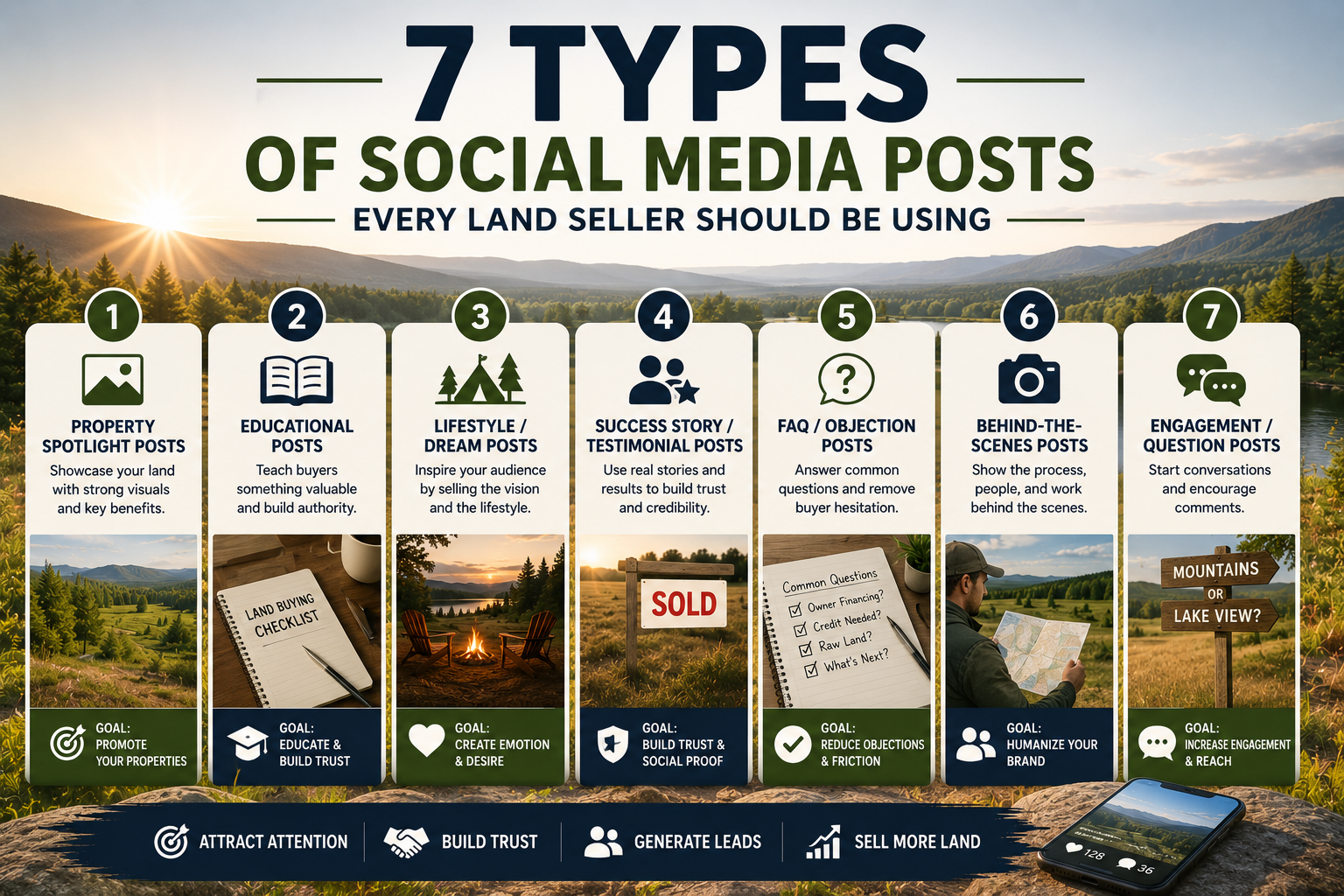
7 Types of Social Media Posts Every Land Seller Should Be Using
Discover 7 powerful types of social media posts land sellers should use to attract buyers, build trust, generate leads, and sell more land online.
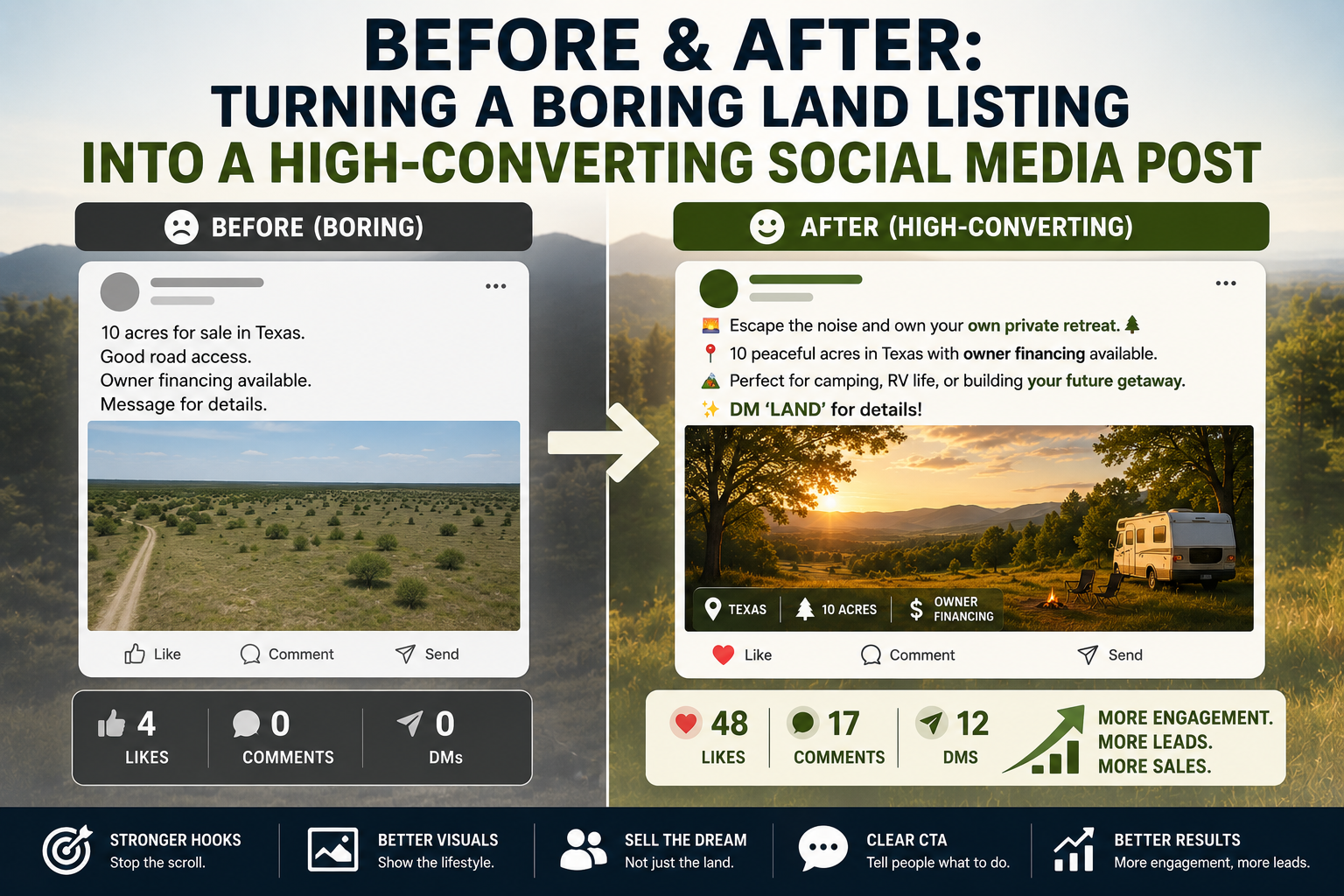
Before & After: Turning a Boring Land Listing Into a High-Converting Social Media Post
See how to transform a boring land listing into a high-converting social media post using better visuals, storytelling, emotional hooks, and stronger calls-to-action.
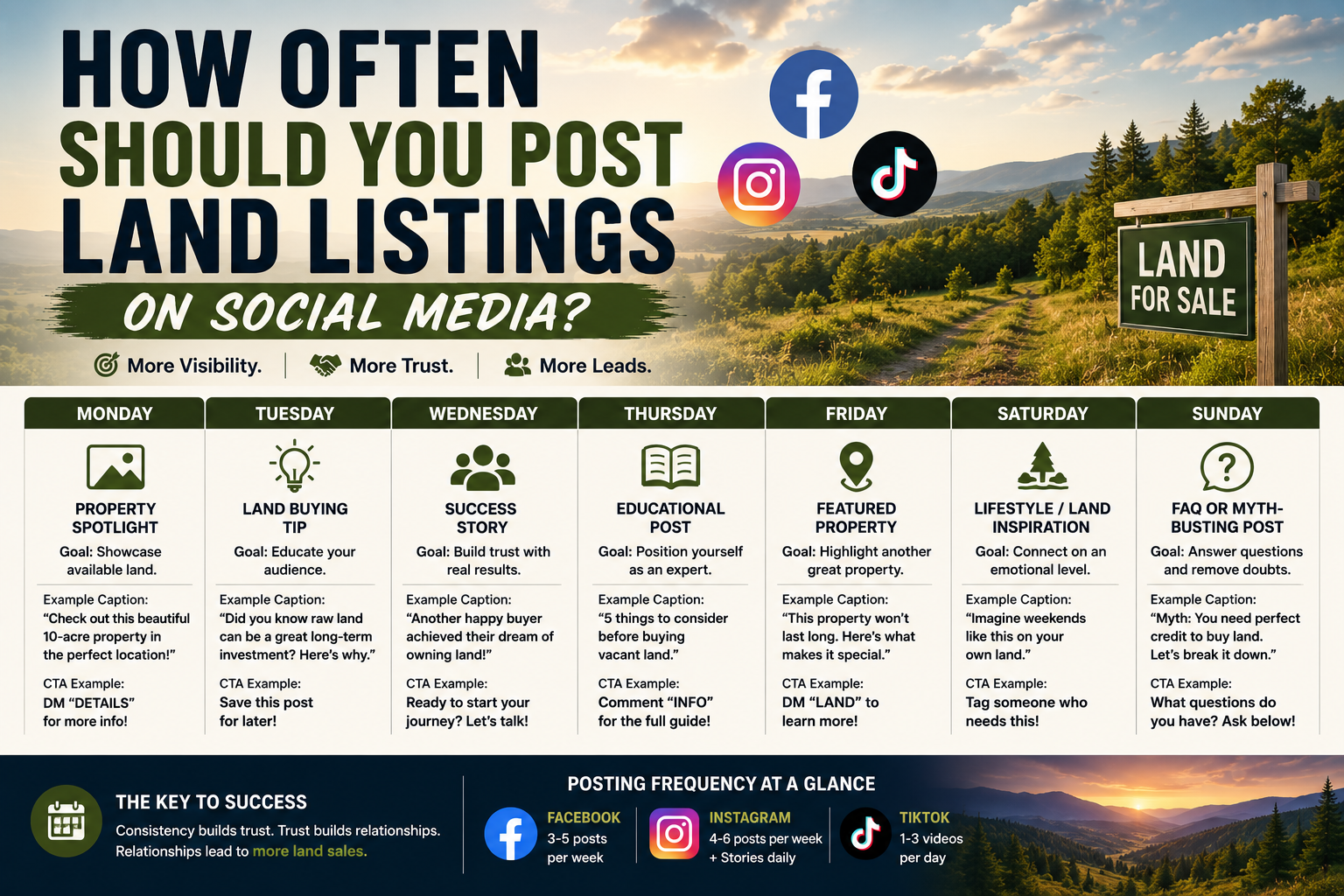
How Often Should You Post Land Listings on Social Media?
Discover the ideal posting frequency for Facebook, Instagram, and TikTok when marketing land. Learn how often successful land sellers post and how to stay consistent.