Most land sellers have the same problem. They write a post, upload a photo, and wait. The engagement never comes. A few likes from family members. Zero DMs. Zero leads.
The land is real. The price is fair. The owner financing is available. And still — nothing.
The issue is almost never the property. It is the presentation.
Social media is not a bulletin board. It is an attention economy. Every post competes with hundreds of others in the same feed, and buyers decide within two seconds whether something is worth their time. If your post looks like every other land listing — a basic photo, a few technical specs, and a vague "message for details" — it will disappear into the scroll without a second glance.
This guide walks through a complete land listing transformation: what a typical bad post looks like, why it fails, what the improved version looks like, and the specific steps that separate invisible listings from high-converting land posts.
Small changes in how you present a property can dramatically increase engagement and leads — without spending a dollar on ads.
Why Most Land Listings Fail on Social Media
Before we look at the transformation, it helps to understand exactly what is going wrong.
Most land sellers write their social media captions the same way they would write an MLS description. They list the facts: acreage, location, access, price. They upload whatever photo they have from the drone. They add "owner financing available" at the end. They hit post and hope.
This approach fails on social media for several reasons.
Weak visuals. A flat aerial shot with no focal point gives buyers nothing to feel. Emotion drives action, and a bland photo creates no emotion.
No emotional hook. The first line of most land listings tells people nothing worth stopping for. "10 acres for sale in Texas" is information, not a reason to pay attention.
No storytelling. People do not just buy land. They buy the idea of what that land means — freedom, investment, escape, opportunity. Listings that skip the story and go straight to specs miss the reason people buy in the first place.
Generic captions. When every post sounds the same, none of them stand out. Buyers gloss over captions that read like automated MLS exports.
No CTA. "Message for details" is not a call to action. It is a passive request that puts the burden entirely on the buyer. Strong CTAs reduce friction and tell people exactly what to do next.
Too much information. Long blocks of text, legal descriptions, GPS coordinates, and zoning details buried in a social post overwhelm buyers who are browsing casually. Too much information kills curiosity instead of creating it.
Social media users scroll fast. They are not researching a purchase — they are deciding in two seconds whether something deserves a second look. If your post does not earn that second look, nothing else matters.
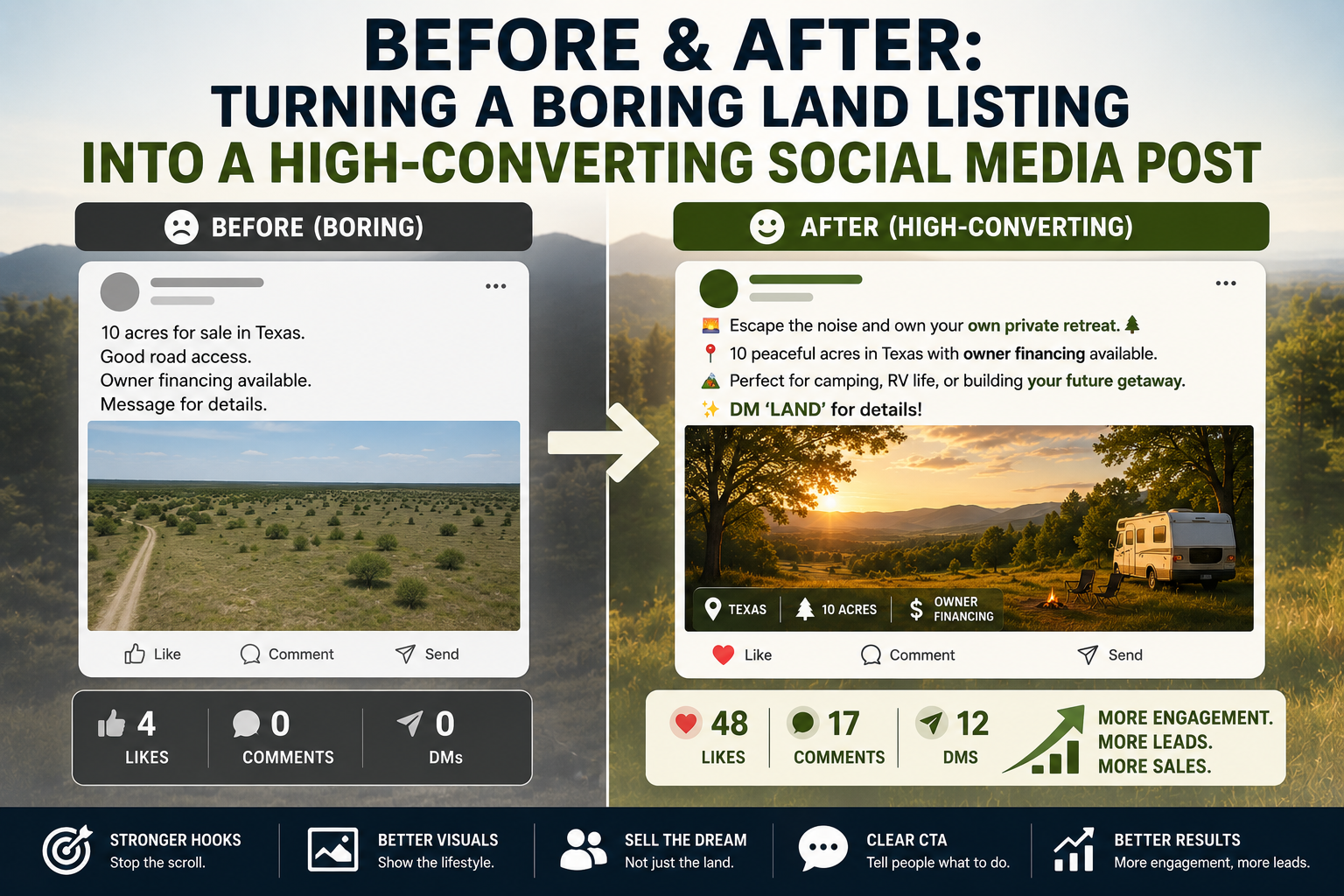
BEFORE: The Typical Boring Listing
Here is what the average land listing looks like on social media:
Caption: "10 acres for sale in Texas. Good road access. Owner financing available. Message for details."
Image: Basic daytime aerial drone photo. No branding. No overlays. No focal point. The land looks flat and anonymous.
This post is not wrong. All the important information is there. But it fails at every level that actually matters on social media.
Why this fails:
The caption sounds like it was copied directly from a property sheet. It uses no emotional language, tells no story, and gives the reader no reason to stop scrolling. "Good road access" is a feature, not a benefit. "Message for details" is vague — what details? What are they getting when they reach out?
The photo provides no atmosphere. An aerial drone shot of open land without any framing, lighting quality, or context looks identical to hundreds of other posts in the same feed. There is nothing to make someone think "that looks like somewhere I want to be."
The result: a post that generates a few passive scrolls, maybe two or three likes from existing followers, and no genuine inquiries.
This is not a rare case. It is the default for most land sellers marketing land on social media.
AFTER: The High-Converting Version
Now here is the same property — same acreage, same location, same financing — rewritten and reframed:
Caption: "Escape the noise and own your own private retreat 🌅
10 peaceful acres in East Texas with owner financing available.
Perfect for camping, RV life, or building your future getaway — no credit check, small down payment, easy monthly terms.
DM 'LAND' for the full property sheet."
Image: A golden-hour photo showing the tree line at the back of the property with warm light breaking through. A clean text overlay in the lower corner reads: "10 Acres — Owner Financed — East Texas." The image has one clear focal point and creates a feeling of calm, space, and possibility.
This version performs better for reasons that are entirely predictable.
Why this works:
The opening line does not describe the property — it describes a feeling. "Escape the noise" speaks directly to what the buyer wants. It creates a mental image before a single property detail appears.
The use case framing (camping, RV life, getaway) helps buyers picture themselves there. People buy land with their imagination first.
The financing details are included but not buried. They are presented as benefits — "no credit check, small down payment, easy monthly terms" — not just a feature checkbox.
The CTA is specific. "DM 'LAND' for the full property sheet" tells the buyer exactly what to do and exactly what they will get. That reduces friction and increases response rate.
The visual creates an emotional atmosphere. Golden-hour lighting communicates warmth, peace, and quality. The clean overlay adds information without cluttering the image. The combination looks professional without looking like an ad.
Step 1: Start With an Emotional Hook
The first sentence of your post is doing most of the work. It determines whether someone stops or scrolls.
Most land listing captions open with the property description. That is the wrong starting point. The first line should speak to a desire, a feeling, or a curiosity — not a feature.
Weak hooks:
- "Land for sale in Arizona."
- "12 acres available. Owner financing."
- "Check out this property in rural Tennessee."
Strong hooks:
- "Imagine waking up to this view every weekend."
- "Your future escape starts here."
- "This is what $199 a month gets you in Texas."
- "No bank. No HOA. No restrictions. Just land."
- "Not many properties like this come available at this price."
The best hooks speak to something the buyer already wants and interrupted their scroll to think about. You are not introducing them to land — you are giving them a reason to pay attention to yours.
Emotional marketing is not about exaggerating or being dramatic. It is about connecting your listing to the real reasons people buy land: freedom, investment upside, peace, space, lifestyle. When the hook speaks to one of those motivations directly, engagement follows.
Step 2: Sell the Lifestyle, Not Just the Property
Buyers do not purchase acreage. They purchase what that acreage represents.
Land means different things to different buyers. Some are buying freedom — the ability to do what they want without an HOA, a neighbor's approval, or a zoning board in the way. Some are buying peace — a place to disconnect, reset, and disappear for a weekend. Some are buying investment upside — cheap land in a growing market that will be worth more in five years. Some are buying an escape — a physical counterweight to a demanding life.
None of those motivations appear in a typical land listing caption. But all of them are conversion drivers.
Examples of property-led captions:
"15 acres. No restrictions. AZ. Owner financed."
Examples of lifestyle-led captions:
"Your own 15 acres in Arizona — no restrictions, no HOA, no one telling you what to build or when to show up. Owner financed with terms that actually work."
The property description is identical. The emotional resonance is completely different. The second version creates a picture of ownership that the buyer can feel before they even know the price.
When you sit down to write a caption, ask yourself: What does owning this land actually feel like? Write that first. Add the facts second.
Step 3: Improve the Visuals
Your visual is the first thing someone sees. It is doing the selling before a single word is read.
Most land sellers use whatever photo they have available — usually a daytime drone shot that looks flat and informational rather than emotional and appealing. That approach is fine for an MLS listing. It does not work on social media.
❌ What to avoid:
- Flat, overcast aerial shots with no focal point
- Blurry or poorly lit photos
- Over-designed graphics with too many fonts, colors, and overlays
- Stock landscape photos that have nothing to do with the actual property
- Images that look like banner ads — they trigger the same "skip" reflex as paid content
✅ What works:
- Golden-hour or blue-hour lighting that creates warmth and atmosphere
- Ground-level shots that let buyers see themselves standing on the property
- Lifestyle imagery — a tent, a fire pit, a parked truck — that visualizes how the land would be used
- A clean, minimal overlay with the key facts: acreage, state, and financing availability
- One clear focal point: a tree line, a horizon, a water feature, a hillside view
Visuals that create emotion outperform visuals that just document. The goal is one instant reaction from the viewer: "That looks like somewhere I'd want to own land."
LandGenie helps land sellers generate clean, branded property visuals from their listing details — formatted for different platforms and designed to feel native in social feeds rather than promotional.
Step 4: Simplify the Message
More information does not create more leads. It creates more confusion.
Land sellers often include everything in a post: GPS coordinates, legal descriptions, zoning classifications, county assessor links, survey details. The instinct is understandable — the more informed the buyer, the better the conversation. But on social media, too much information kills curiosity instead of satisfying it.
A buyer who can answer every question from your post has no reason to DM you.
What to cut:
- Legal descriptions and parcel IDs
- County assessor links mid-caption
- Flood zone information unless it is a selling point
- Multiple use cases stacked in one sentence
- Anything that requires research to understand
What to keep:
- Acreage and state (or county if relevant)
- The strongest use case or lifestyle angle
- Financing terms in plain language
- One clear CTA
The goal is to give buyers enough to feel interested and just enough friction removed that reaching out feels easy. Save the details for the DM conversation.
Short captions. Easy to read. One message. One CTA.
Step 5: Add a Strong CTA
The difference between "message for details" and a post that generates 15 DMs in 24 hours is usually the call to action.
Weak CTAs are vague. They put the burden on the buyer to figure out what to do and what they will get. Strong CTAs are specific. They tell the buyer exactly what to do and exactly what happens next.
Weak CTAs:
- "Message for details"
- "Contact us for more info"
- "DM if interested"
Strong CTAs:
- "DM 'LAND' and I'll send the full property sheet"
- "Comment 'INFO' below and I'll reach out with everything"
- "Want the map and photos? Just say the word"
- "Reply 'INTERESTED' and I'll send pricing and terms"
- "DM me and I'll send the aerial + owner financing breakdown in 5 minutes"
Keyword-triggered CTAs ("DM 'LAND'") work especially well because they create micro-commitment. The buyer types one word. That single action signals intent and starts the conversation.
Every post you write should have exactly one CTA. Multiple CTAs dilute the signal and confuse buyers about what you actually want them to do.
Step 6: Create Curiosity
Curiosity is one of the most reliable engagement drivers on social media. When a caption creates an open loop — a question, a surprise, a gap in information that the buyer wants to close — they engage to resolve it.
Examples of curiosity-driven hooks:
- "This property is getting attention fast — here's why."
- "You won't believe what owner financing can get you here."
- "Most people don't know land like this is still available at this price."
- "This one surprised me when I saw the photos."
The goal is not clickbait. Curiosity should feel earned, not manipulative. If you say "this property is getting attention fast," it should be because there is genuinely something compelling about it. Curiosity that leads to a disappointing reveal destroys trust.
When used correctly, curiosity makes buyers lean in. They want to know what makes this property different. They comment. They DM. They click.
That engagement signals to the platform's algorithm that your content is worth distributing further — which means more reach without any additional spend.
Step 7: Match the Content to the Platform
The same property should not be posted identically across every platform. Each platform has its own culture, format expectations, and audience behavior. What converts on Facebook often underperforms on Instagram. What works on Instagram needs to be rebuilt entirely for TikTok.
Facebook:
Facebook posts can be longer and more conversational. Group audiences and older demographics respond well to direct language, clear financing details, and community-oriented framing. Opening with a question ("Anyone here looking for land with no HOA?") creates engagement that the algorithm rewards with reach.
- Best length: 3–5 short paragraphs
- Best format: Conversational, helpful tone with a soft CTA
- Visual: Strong photo with minimal or no overlay
Instagram:
Instagram is visual first. The image or video does most of the persuasion work. The caption can be shorter — a strong hook, a brief benefit statement, and a clear CTA. Hashtags still contribute to discovery. Reels showing the actual land or a lifestyle moment significantly outperform static photos.
- Best length: 3–6 sentences
- Best format: Emotional, visual-first, lifestyle-driven
- Visual: High-quality, atmosphere-focused, single focal point
TikTok:
TikTok rewards speed, personality, and emotion. A 15–30 second video showing the land with a voiceover that speaks to the lifestyle opportunity outperforms any static post. Lead with the most surprising or compelling detail in the first three seconds. Do not save the hook for the middle.
- Best length: 15–45 second video
- Best format: Fast-paced, authentic, curiosity-driven
- Visual: Raw, real footage — not over-produced
Repurposing the same content across all platforms without adapting it is one of the most common mistakes in social media marketing for land sellers. Every platform has its own grammar. Learn it.
Real Metrics: What the Difference Looks Like
Here is a realistic comparison of what two versions of the same post generate:
Before (standard listing post):
| Metric | Result |
|---|---|
| Likes / Reactions | 4 |
| Comments | 0 |
| DMs received | 0 |
| Leads generated | 0 |
After (optimized post with hook, lifestyle framing, clean visual, strong CTA):
| Metric | Result |
|---|---|
| Likes / Reactions | 48 |
| Comments | 17 |
| DMs received | 12 |
| Leads generated | 7 |
The property is identical. The price did not change. The financing terms did not change. The only thing that changed was the presentation.
Better visuals, a stronger hook, a cleaner message, and a specific CTA did not just increase vanity metrics — they directly increased the number of real buyer conversations. That is what the transformation is actually about.
The Psychology Behind High-Converting Posts
Understanding why these techniques work makes them easier to apply consistently.
Emotion drives action. Buyers make decisions based on how something feels, then justify those decisions with logic. Land listings that lead with emotion — a visual, a lifestyle hook, a sense of what ownership would feel like — create the emotional response that precedes a buying decision.
Storytelling builds connection. When a post tells a story — even a brief one — the buyer sees themselves in it. "Imagine waking up to this view" is a micro-story. The buyer becomes the protagonist. That connection is worth more than a list of features.
Simplicity signals confidence. Sellers who over-explain often appear uncertain about whether their property can sell itself. Clean, concise posts that highlight one or two key benefits signal that the seller knows what they have — and that confidence is contagious.
Trust reduces friction. A professional visual, consistent branding, and a clear CTA signal competence. Buyers who feel like they are dealing with a serious, professional seller are more likely to take the next step.
Social proof amplifies everything. Comments and engagement on a post make it more credible to the next person who sees it. A post with 17 comments is inherently more trustworthy than a post with zero — even if the commenter just said "interested." Engagement begets engagement.
These principles are not specific to land. They are the principles of all effective social media content. Applying them to land listings transforms how your properties are perceived before a buyer ever contacts you.
Common Mistakes to Avoid
❌ Overloading information. Long posts packed with technical details overwhelm buyers. They skim, decide it is too much work, and scroll. Save the details for the follow-up DM.
❌ Weak images. A blurry, flat, or poorly lit photo is worse than no photo. It signals low effort and makes buyers wonder what else you are cutting corners on. Invest time in better photography or better visual presentation.
❌ No CTA. A post without a CTA is a post that ends without direction. Buyers who are interested but given no next step will simply not take one. Always tell them exactly what to do.
❌ Sounding robotic. MLS-style language does not belong on social media. If your caption sounds like it was generated by a property database, it will be ignored like one. Write the way a person talks.
❌ Posting only listings. Feeds that consist entirely of listings feel like spam. Mix in helpful content, buyer questions, success stories, and property education. Listings convert better when they appear in the context of a real presence.
❌ Generic copy-paste captions. Using the exact same caption structure for every property in every post trains your audience to stop reading. Varied, property-specific content gets more attention and more engagement.
Before & After Transformation Checklist
Use this before you publish your next post:
- Emotional hook — Does the first line speak to a desire, feeling, or curiosity instead of a feature?
- Better visuals — Does the image create atmosphere, emotion, or a clear focal point?
- Lifestyle angle — Does the caption help buyers imagine themselves owning and using this land?
- Cleaner design — Is the visual free of clutter, excessive text, and over-designed elements?
- Clear CTA — Is there one specific next step that tells buyers exactly what to do?
- Simpler copy — Is the caption short, easy to read, and free of unnecessary information?
- Curiosity element — Does the post create an open loop or a reason to want to know more?
- Platform-specific formatting — Is the post adapted for where it is being published?
If you can check every box before hitting publish, you are posting at a level that most land sellers never reach.
How LandGenie Helps Transform Listings Faster
Writing one strong listing post is doable. Writing strong posts consistently — for multiple properties, across multiple platforms, week after week — is where most land sellers fall behind.
The transformation process above requires time, skill, and attention to detail on every single post. Most sellers know what good content looks like. The gap is execution at scale.
LandGenie helps bridge that gap.
You enter your property details. LandGenie rewrites the caption with an emotional hook, lifestyle framing, and a clear CTA. It generates multiple variations — one for a Facebook Group, one for Instagram, one for a short-form video script — so you can post the same property across platforms without copying and pasting the same bland description.
It also helps you maintain visual consistency: clean, branded property images that look professional without looking promotional, formatted for the platform where they will appear.
The result is a library of high-converting land posts built in minutes instead of hours — content that reflects the actual quality of your properties rather than blending into the noise.
Final Thoughts
The property is almost never the problem.
Land sellers who struggle to generate engagement are not usually selling bad land at bad prices. They are presenting good land in ways that make it look the same as every other listing in the feed.
The transformation from a boring listing to a high-converting social media post is not complicated. It requires an emotional hook, a visual that creates atmosphere, copy that sells the lifestyle instead of just the acreage, a message simple enough to read in seconds, and a CTA that tells buyers exactly what to do next.
Those are not advanced marketing skills. They are habits — and once you build them, every post you publish works harder for you.
Start with your next property. Run it through the checklist. Compare it to where you started. Then track what happens.
Better content creates better engagement. Better engagement creates more leads. More leads create more sales. The presentation is where it all begins.
If you want to create better land content faster and more consistently, LandGenie is built to help you do exactly that.
Related Guides
LandGenie Team
LandGenie helps land sellers, investors, and wholesalers create AI-powered marketing content for listings, social media ads, and buyer-focused copy — faster and without needing design or copywriting skills.
Create Better Land Marketing Content in Minutes
LandGenie helps you turn property details into social posts, listing captions, ad copy, and AI-generated visuals. Review, download, and post whenever you are ready.
Try LandGenie FreeRelated Guides
The Perfect Formula for Writing Land Listing Captions That Convert
Learn how to write high-converting land listing captions using proven formulas, emotional hooks, before/after examples, and 25+ caption templates by land type.
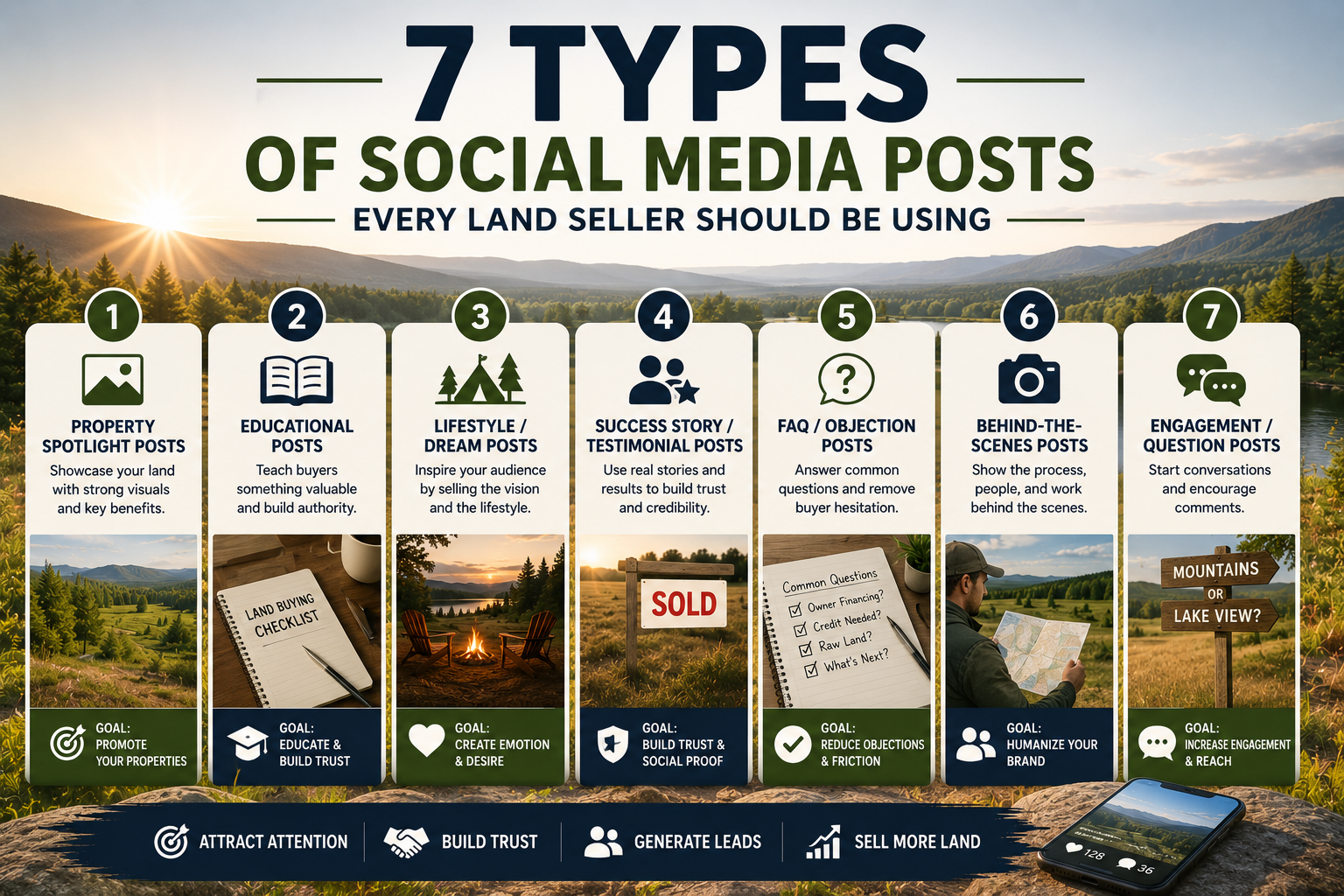
7 Types of Social Media Posts Every Land Seller Should Be Using
Discover 7 powerful types of social media posts land sellers should use to attract buyers, build trust, generate leads, and sell more land online.
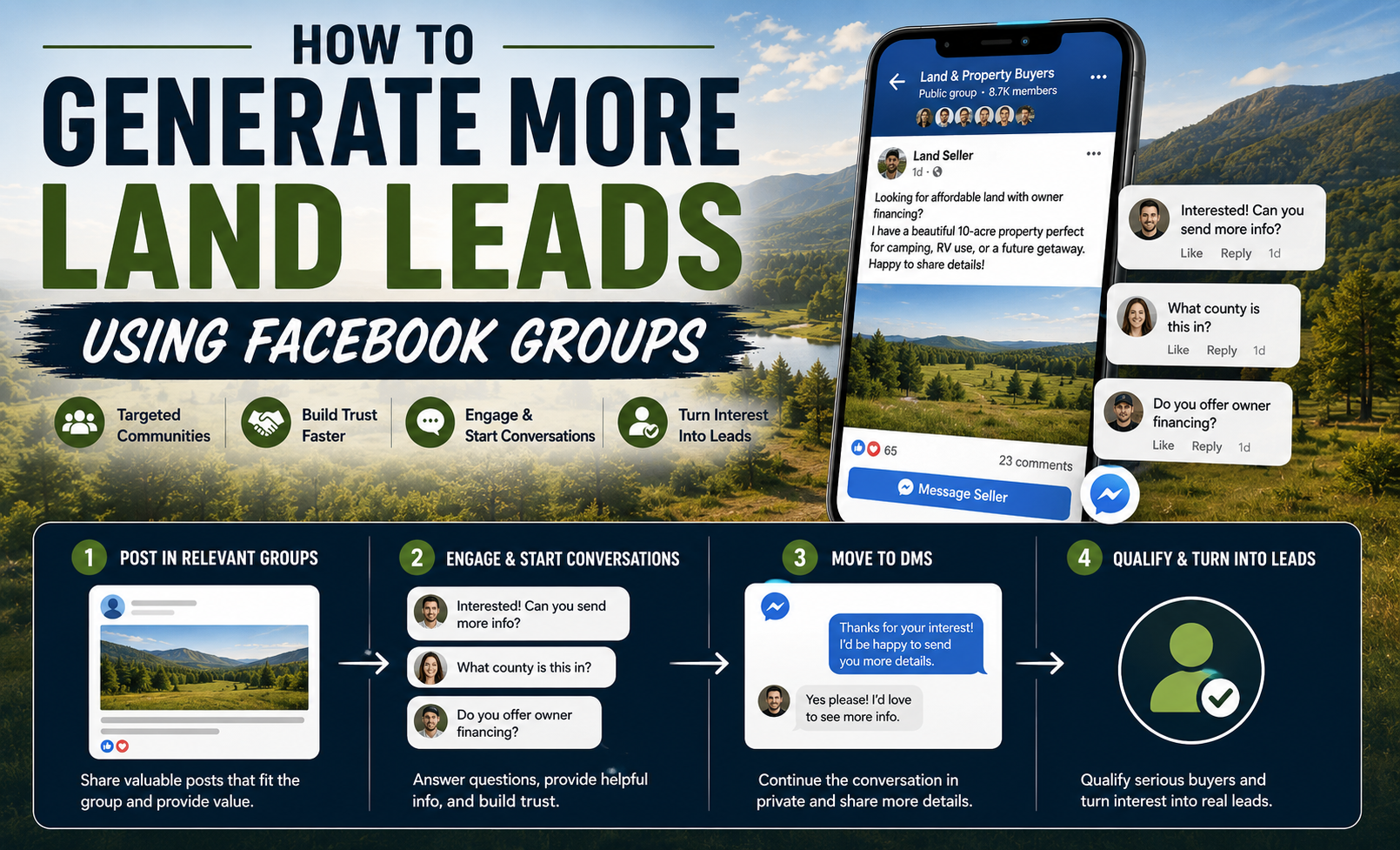
How to Generate More Land Leads Using Facebook Groups
Learn how to generate more land leads using Facebook Groups. Discover practical strategies for finding the right groups, posting effectively, building trust, and turning engagement into buyers.